

Build with Us
Portable Data Node
Player handheld for Quickdraw, field play, and Mission Control
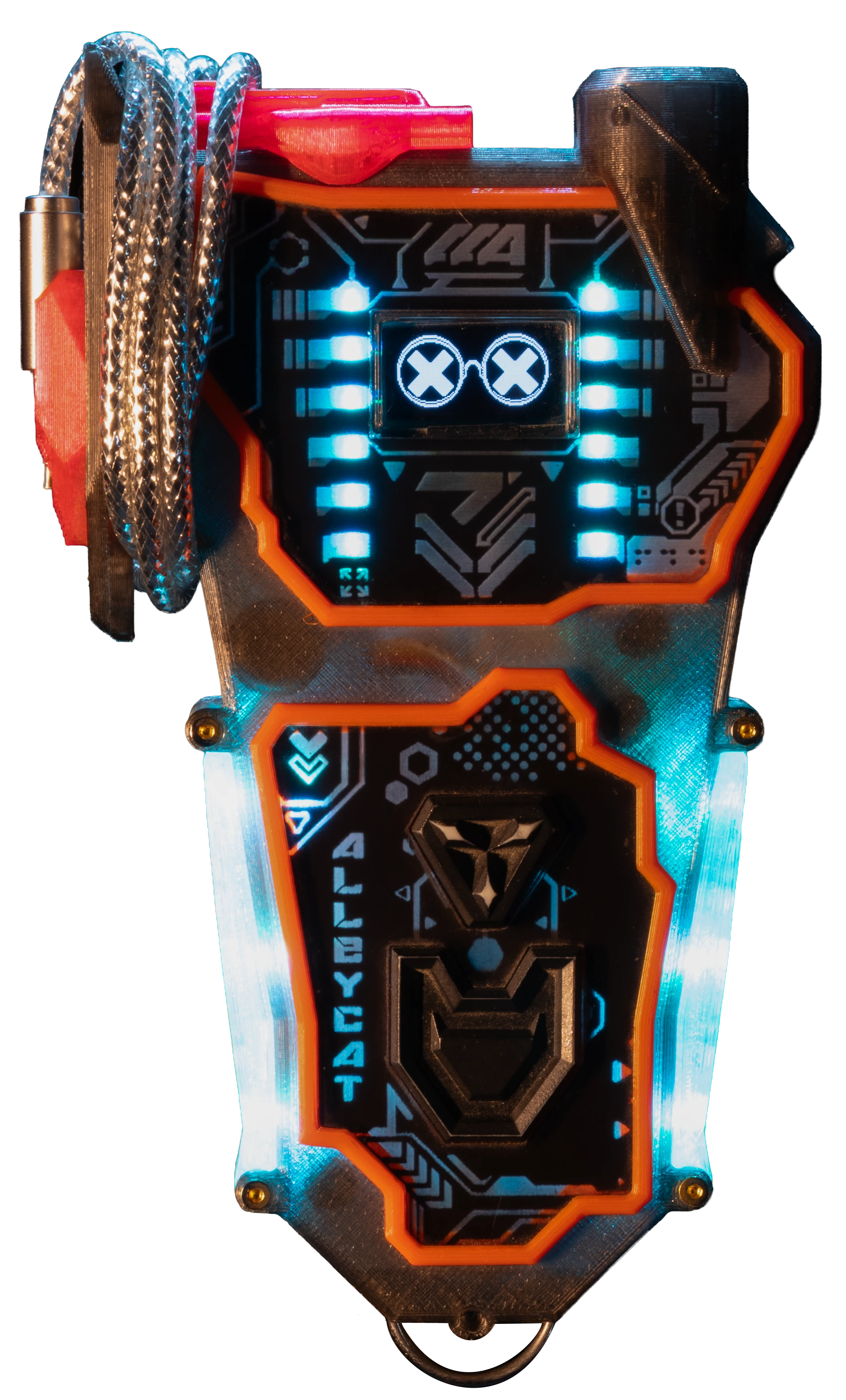
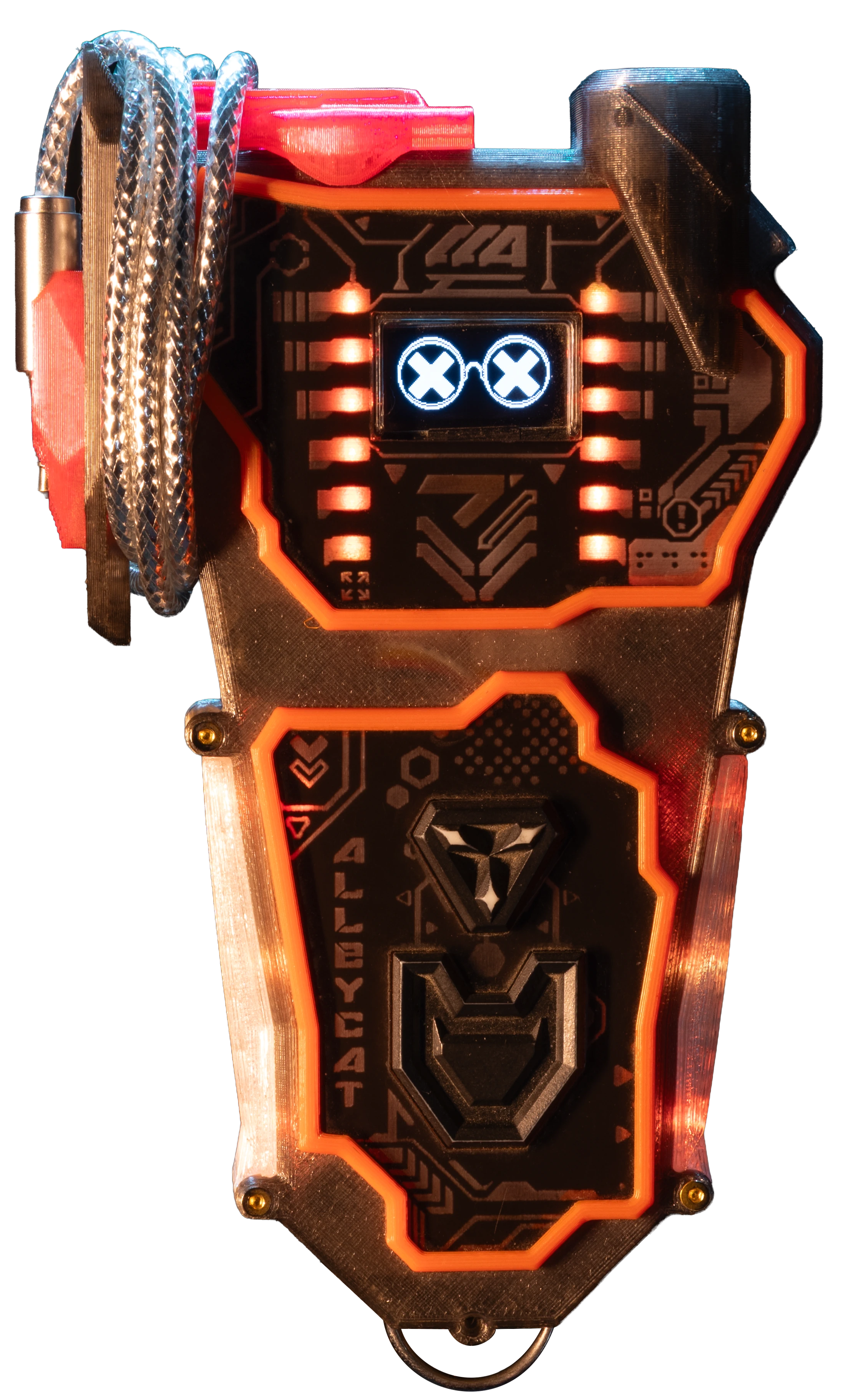
The Portable Data Node is what every player carries at an Alleycat event. In our bounty hunting game players jack two PDNs together for Quickdraw: countdown, Go, first button press wins. The device tells you the results; Mission Control can push colors, haptics, and mode changes over the air while you stay in the fiction.
Under the hood the current generation is an ESP32-S3 handheld with Wi-Fi and Bluetooth, a 128×64 OLED, 19 addressable LEDs, two buttons, serial over 3.5 mm jacks, USB-C, and a 2000 mAh battery.
Generations
| Era | Name | Notes |
|---|---|---|
| Neo 2024+ | PDN MK I | First custom PCB; one unit, either role via firmware and lighting. |
| Neo 2025+ | PDN MK II | Refined enclosure, ESP-NOW wireless scoring, shared BOM with MK I. |
Year-by-year engineering: start with the Neo 2024 dispatch (PDN MK I crisis build) and then the Neo 2025 dispatch (PDN MK II refined build).
Bill of materials (PDN MK I and PDN MK II)
| Part | Detail |
|---|---|
| MCU | ESP32-S3 N8R8 |
| Battery | 2000 mAh rechargeable |
| Programming | USB-C over JTAG |
| Display | 0.96" 128×64 monochrome OLED |
| Haptics | 10k RPM motor |
| Input | 2× buttons |
| LEDs | 19× WS2812B |
| Serial I/O | 2× serial-over-3.5 mm aux ports |
How we use it in the field
Quickdraw is the front door: a fair duel without a staff referee. Posse and Shootout modes chain multiple PDNs for multiplayer additions. Players also jack into FDN nodes for puzzles, minigames, and more. The device is meant to stay out of the way: simple rules in firmware, story in the space between people.
Firmware uses a hardware abstraction layer and a state machine so game modes can grow without rewriting pin maps. Schematics, PlatformIO projects, and assembly notes live in the open so you can fork the stack for your own event.
Read how we think about the work for the design principles behind the hardware.